


Missing Tooth: Implant, Bridge or Denture?

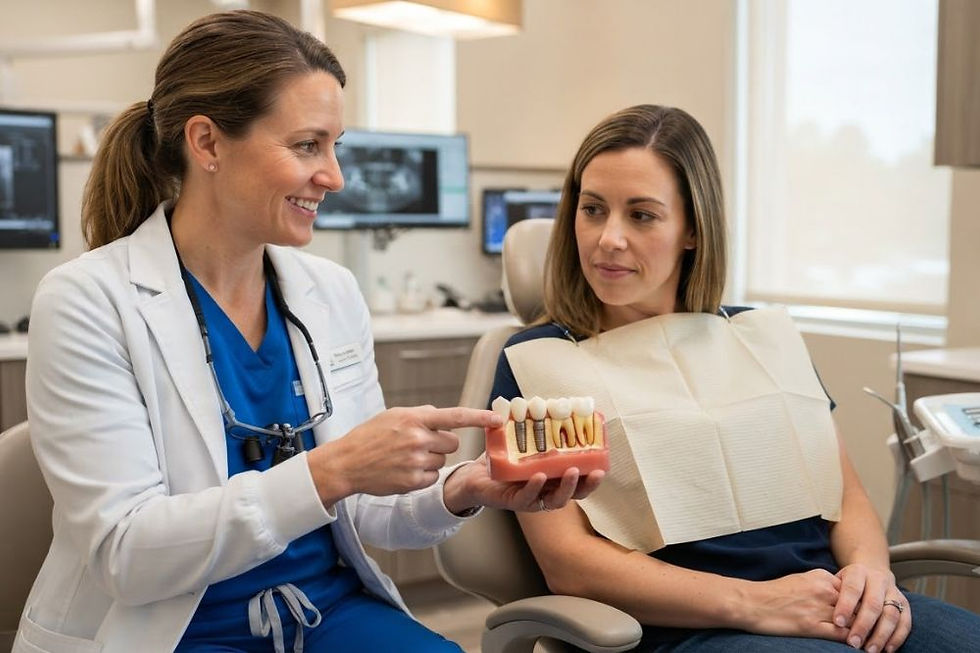
Losing a tooth can shake your confidence. Maybe it happened after an accident, a cracked tooth, or a tooth extraction, and now you're left with a gap and a lot of questions. How will my smile look? Will I be able to chew properly? How long will treatment take, what will it cost, and will the teeth around the gap be affected?
The answer is–you don't need to live with the gap forever. With three proven missing tooth replacement options- a dental implant, a dental bridge, or a denture you restore your ability to chew, speak, and smile comfortably.
Each one works differently, and the suitable way to replace a missing tooth depends on where the gap is, the health of your gums and jawbone, the condition of the nearby teeth, and your budget and preferences. So which one should you choose? The right choice comes down to your teeth, gums, bone, budget, and how quickly you want the gap filled.
Why You Shouldn't Just Leave the Gap
It's easy to ignore a missing tooth, especially if it's toward the back and nobody can see it. But a gap doesn't stay a gap for long.
Neighbouring teeth drift: Leaving a missing tooth gap untreated can allow nearby teeth to shift into the space. The changes in tooth position can affect how your upper and lower teeth meet.
The jawbone shrinks: Bone needs the pressure, like a bite or chew of a tooth root, to stay strong. Without it, the bone in that area begins to resorb, often noticeably within the first year.
Chewing gets harder: Many people unknowingly start chewing on one side, which can strain the jaw over time. Food can also become trapped in the gap.
Confidence dips: Missing teeth can make some people feel self-conscious. They may smile less, cover their mouth while talking or laughing.
The impact varies based on the missing tooth’s location, the condition of your remaining teeth, and your bite. That's why dental professionals look at the whole mouth, rather than treating a missing tooth as an isolated cosmetic concern.
4.4% of Canadian adults aged 18+ reported having lost all their natural teeth in the 2023–2024 Canadian Oral Health Survey.
Note: The sooner you explore options for replacing missing teeth, the more choices you'll usually have.
What Are the Main Tooth Replacement Options?
For one missing tooth, your dentist may discuss a dental implant, bridge or denture. All three can replace a missing tooth, but they do not work in the same way.
Choice 1: Dental implant for a missing tooth
A dental implant replaces the root of a missing tooth. A small implant, usually made from titanium, is placed into the jawbone because titanium is biocompatible and can bond with the surrounding bone.
After implant placement, the gum tissue around the implant site repairs itself while the bone slowly grows and creates a firm connection to the implant.
A typical single-tooth implant has three main parts:
Implant: A small post placed into the jawbone.
Abutment: A connector attached to the implant.
Crown: The artificial tooth placed on top.
Why do some people choose an implant?
It looks, feels and works like a natural tooth.
It doesn't rely on neighbouring teeth for support.
It helps preserve the jawbone because the post stimulates the bone like a real root.
With good care, dental implants can often last 20 years or longer.
Things to keep in mind
It's the highest upfront cost of the three options because treatment may involve an implant post, surgery, healing time, an abutment and a crown.
Implant healing happens in stages; it may take a few months from placement to final crown because the bone needs to heal around the implant.
You need enough healthy bones and healthy gums. If bone has been lost, a bone graft may be needed first.
Smoking and uncontrolled diabetes can lower success rates, so your dentist will want to talk about your overall health.
A dental implant is often the first option dentists recommend, provided you're a good candidate.
Choice 2: Dental bridge for a missing tooth
A dental bridge is a fixed dental restoration used to replace a missing tooth by filling the gap with an artificial tooth, called a pontic. The natural neighbouring teeth or dental implants support it.
Compared with a removable denture, a dental bridge stays in place and can help you chew, speak, and smile.
Why do people choose a bridge
You may get a fixed replacement.
It's faster. The process typically takes a few weeks rather than months
No surgery is involved
The neighbouring teeth are ideal to support the bridge.
The upfront cost is usually lower than an implant
It looks natural and restores normal chewing
What to consider
The teeth next to the gap must be filed down to hold the crowns. If those teeth are perfectly healthy, that's a real trade-off.
A bridge doesn't stop bone loss under the missing tooth.
Cleaning underneath takes extra effort (floss threaders or a water flosser help)
Bridges generally last around 10 to 15 years with good care, then may need replacing.
A traditional bridge does not require an implant to be placed into the jawbone.
Important: The supporting teeth usually need to be prepared for the crowns. This is an important point to discuss if those neighbouring teeth are healthy.
Choice 3: Denture for a Missing Tooth
Partial dentures replace some missing teeth while using remaining natural teeth for support and stability through components such as clasps or other supporting parts. However, the exact teeth used depend on their location, strength and condition.
Why people choose a partial denture
Budget-friendly plan to fill the gap
No surgery and no cutting down healthy teeth
Quick to make and easy to adjust or add teeth to later
A good option when several teeth are missing
What to consider
It can feel bulky at first, and there's an adjustment period for your mouth, tongue and facial muscles to adjust to new dentures.
Mild tenderness, increased saliva, changes in speech or chewing can occur.
It needs to be removed and cleaned daily.
It doesn't prevent bone loss, and it usually needs replacing or relining every 5 to 8 years.
Note: Some people use a partial denture as a temporary solution while saving for an implant, and that's a perfectly reasonable plan.
Dental Implant vs Bridge vs Denture: Which Tooth Replacement Option May Fit You
Factor | Dental Implant | Dental Bridge | Partial Denture |
Definition | A replacement tooth anchored into the jawbone | A fixed replacement tooth supported by neighbouring teeth | A removable replacement for one or more missing teeth |
Replace root? | Yes | No | No |
Surgery? | Yes | No | No |
Uses neighbouring teeth? | No | Yes, usually | Sometimes |
Helps preserve bone? | Yes | No | No |
Fixed or removable? | Fixed | Fixed | Removable |
Treatment time | Several months | Usually a few weeks | Usually a few weeks |
Natural feel | Very natural | Natural | May feel different initially |
Cleaning | Brush + clean around implant | Brush + clean underneath | Remove and clean daily |
Typical lifespan | Many years | Often 10–15 years | May need adjustment/replacement |
Cost | Usually highest | Usually moderate | Often lower |
Main benefit | Independent, fixed replacement | Fixed and quicker | Removable and practical |
Main consideration | Surgery and healing | Neighbouring teeth may need preparation | Adjustment and daily removal |
Note: Timelines and lifespans vary by person. Your dentist will give you an estimate based on your mouth.
Dental Implant vs Bridge: Which Option May Be Right?
Implants and bridges solve the same problem in very different ways.
An implant gets its support from the jawbone. A traditional bridge gets its support from the teeth beside the gap.
With an implant, the artificial root is placed in the jawbone. With a traditional bridge, the artificial tooth is supported by neighbouring teeth.
That means the two treatments involve very different processes.
What to Expect During the Dental Implant Process
Getting a dental implant is not possible in one visit. The treatment is planned around your oral health, the condition of the missing-tooth area, and the type of restoration you need. At Dentistry at Sullivan in Scarborough, the process typically involves several stages.
Consultation and Examination: Dr Sepideh Maleki and her dental team will discuss your missing tooth or teeth, concerns, expectations, and preferred treatment result.
Jawbone Assessment: The dental team will check the amount and condition of jawbone around missing teeth to see if the site can support an implant.
X-Rays or CBCT 3D Imaging: To check the location of missing teeth, gum health, remaining teeth, bite, general health, and healing considerations, the dentist recommends X-rays. For more detailed information, the team will use CBCT 3D imaging to plan treatment.
Prepare the Treatment Site: If needed, tooth extraction, bone grafting, or other dental treatment is completed before the implant can be placed.
Plan Implant Placement: Our dentist will analyse the exam and any additional testing and plan the site and approach for the implant.
Place the Implant: The implant is surgically placed in the jawbone under local anaesthesia once the area has been prepared for the implant.
Let it Heal: The implant needs time to heal in the place it was placed before the final restoration can be attached.
Complete the Restoration: Once implant healing is adequate, the crown, bridge, or denture is attached as planned to replace the missing tooth.
Keep Up Care: Regular dental exams, daily cleaning, and following your dentist’s recommendations help maintain the implant and surrounding tissue.
How Is a Dental Bridge Placed?
Getting a dental bridge usually involves two or more appointments (depending on the type of bridge and oral health).
At Sullivan in Scarborough, Dr Sepideh Maleki and her dental team will first examine the missing-tooth area, supporting teeth, implants, or bite to ensure the planned bridge may fit easily.
Dental examination & Treatment Planning: The team may examine your teeth, gums, bite, and the structure around the missing tooth with X-rays or CBCT.Based on the findings, your dental team will determine whether a traditional, cantilever, Maryland, or implant-supported bridge is right for you.
Taking impressions: The team takes an impression or digital scan of your teeth for measurement. This will help to create a custom dental bridge that fits your mouth and bite.
Wearing a temporary bridge: Sometimes a dentist may place a temporary bridge while your permanent restoration is being made. It helps protect the prepared teeth and gums during this period.
Fitting the permanent bridge: In the next appointment, the team removes the temporary bridge and checks the permanent restoration for fit, appearance, and bite. Once everything is properly adjusted, the bridge is securely cemented.
Aftercare & regular checkups: A dental bridge needs regular brushing and cleaning underneath and around the restoration. Our team may show you how to use floss or an interdental cleaning method around the bridge.
Choose an implant if you want the longest-lasting result, you want to protect your bone, and your neighbouring teeth are healthy, and you'd rather leave them alone.
Choose a bridge if you want a faster fix, you'd rather avoid surgery, or your neighbouring teeth already need crowns.
Important: Over 15 to 20 years, an implant often works out to be the better value, because bridges usually need to be redone at some point. But "better" depends on your health, budget and timeline.
5 questions to ask yourself for a better decision
How healthy are the teeth beside the gap?
Is my jawbone strong enough for an implant?
What's my time? Is it done before a wedding or a big trip? A bridge may fit better.
What's my budget, and what does my CDCP or insurance cover?
How do I feel about surgery?
What about after a tooth extraction?
If a tooth needs to come out, it's worth planning the replacement before the extraction, not after. In some cases, your dentist can preserve the bone with a socket graft at the time of tooth extraction in Scarborough, which makes a future implant much easier. Ask about it at your consultation.
What About Cost?
Cost can narrow down which options are practical for you.
However, there is no single price for a dental implant, bridge or denture.
Your final cost can depend on:
The number of teeth being replaced
The location of the missing tooth
Whether the tooth has already been extracted
The condition of your gums
Available bone
Whether additional procedures are needed
The type of restoration used
Laboratory and dental fees
Your dental coverage
Note: Ask your dentist for a complete treatment estimate rather than comparing the price of the replacement tooth alone.
Replace Your Missing Tooth With a Ideal Option
Your exam will show which replacement options your mouth can support
At Dentistry at Sullivan, Sepideh Maleki, D.M.D., D.D.S., and her team offer implants, bridges, dentures, extractions, bone grafts, and kids’ fillings in the same location, so patients don’t have to get referred around.
With over 13 years of clinical experience, we start everything with a consultation. A short exam with X-ray or CBCT can help determine which options are realistic for you. You’ll leave with a clear plan and cost estimate.
An implant offers the closest thing to a natural tooth. A bridge is quicker and non-surgical. A denture is the most affordable and flexible. Your dentist can help you weigh the cost, treatment time, bone health, and condition of the teeth around the gap before you decide.


Comments